



A lot of people are talking about GTA VI. Its release is one of the few instances of monoculture you see these days. Some expect the Grand Theft Autoclysm to cause $1 billion in lost productivity in the US, which raises meaningful questions about the social impact and personal opportunity cost of video games. And the release is poised to be the highest-grossing launch of any entertainment product in history, unless you consider tulips a form of art.
But my mind (like the minds of many other men, allegedly) keeps coming back to Lucia. The BBC and other outlets reported that some significant others have vocalized discomfort with the idea that their husbands or boyfriends—and an estimated 85% of GTA fans are male, just to be honest—were participating in a game that prominently featured a parasocial romance with a motion-capture version of trailer-park Irene Adler.
First of all, as a married man expecting his first child in less than four weeks, I sympathize. I know that if I spent a significant portion of my time outside of work not spending time with my wife, shopping for strollers (what we call “Baby CapEx”), and enjoying our Honeymoondämmerung, she would understandably be annoyed. She would be even less thrilled if I spent it buying flowers for a computer-generated felon instead of for her.
Still, I found the (mostly TikTok, admittedly ragebait) backlash against the Lucia romance interesting. What must we believe about human interaction and our relationship to technology to make this a topic worth talking about?
The Player’s Handbook
Anything I say about gameplay is, as one would say in legal practice, “on information and belief.” The story alone runs about 80 hours, performing all games takes closer to 200, and at time of writing, less than 72 hours have elapsed since release.
The mechanics of Jason’s relationship with Lucia seem pretty straightforward. A player can complete tasks like getting a car fixed, doing shared activities, or responding to in-game messages to strengthen the protagonists’ relationship. Not performing these actions and making other choices unbecoming of husband material, like abandoning Lucia to be captured by the police, will erode the relationship.
The granularity of in-game activity that impacts the Jason-Lucia romance is novel and would not have been possible under the technological constraints of prior generations of gaming. But the mechanics hardly seem earth-shattering. Somewhere buried deep in the GTA VI code is a variable that tracks the strength of Jason and Lucia’s relationship. Every time a player succeeds or fails at running an errand or going to the gym with his digital accomplice, that variable keeps the score and filters the consequences into gameplay and cutscenes. This is how Silent Hill 2 worked on PlayStation 2 in 2001.
Admittedly, technology has advanced to the point that the underlying rules of a game are much harder to infer. Significant advances in processing power can create a gaming experience with plausibly chaotic elements: outcomes are governed by rules but subject to so many interacting parameters that they become practically impossible to predict. This helps explain some increasingly sophisticated gameplay features in GTA VI, like the responsiveness of non-playable characters and the forensic inferences made by the police.
But unpredictability is not autonomy. A computer-generated girlfriend whose behavior depends on a thousand interacting variables is still less independent than my wife’s cat. A man (a hypothetical one, surely) who generalizes the Jason-Lucia romance to real-world relationships would implicitly believe that a partner’s feelings can be controlled and optimized. If I enter the cheat codes—that is, if I have certain attributes, if I make certain gestures, or if I say certain phrases—I will receive a certain response.
In fact, I deserve that response.
I am, after all, a nice guy.
But that’s not how real life works.
Real life doesn’t allow replays. Real life doesn’t permit you to make different decisions (to not buy Lucia the flowers this time around) and see what happens instead. Real life also doesn’t guarantee that if you do all the right things, you’ll max out relationship points and get the good ending.
The more realistic game would be one where you can do everything right—buy all the gifts, do all the side quests, hold hands at every opportunity on the fictional Miami beach—and still have the love of your life turn you in to the police.
Wasted
As someone who advises young people on college and career decisions, I sometimes find myself trying to dispel the unspoken assumption that if everything is done right, things have to turn out correctly. If I get perfect grades, if I have the right extracurriculars, if I have the perfect interview, I’ll get the offer letter of my dreams. And if things don’t go my way, I know it’s because I’ve done something wrong or wasn’t good enough.
But that’s simply not true.
Life is full of randomness and unfairness that would make for an awful video game. Real-world accomplishment doesn’t have the same savor as a game where you can discover—through trial and error and at low stakes—how to win it all. And conversely, video games are a dreadful model for how to psychologically handle the arbitrary banality and momentary catastrophes of real life. Dostoevsky does a much better job of that.
Ironically, accepting or even expecting the possibility of undeserved disappointment gives an applicant the courage to make bold choices that maximize their odds of standing out. Once you realize that you’re not living in a video game, the game of life gets a little bit easier.
But there’s a more consequential difference between video games and real life: the irreversibility of commitment.
Video games are remarkably good at capturing the feel of early adulthood. You start with limited resources, encounter obstacles, experiment with different strategies, accumulate skills, and explore your newly found freedom. A young person IRL can change majors, date someone new, or try a different career without suffering catastrophic consequences.
We’ve all seen an example of a simulation with irreversible consequences. If you die in The Matrix, you die in the real world. When the consequences of a simulation become irreversable, the genre begins to shift from entertainment to scifi horror.
The notion that we can respawn in the course of young adulthood is just the mirage effect of having lots of time left. At some point, the goalpost shifts from “discover what you want to do” towards “sustain what you chose to do.” You can change careers at thirty, but you cannot recover six years spent building the wrong one. You can end a relationship, but you cannot return to the person you were before it began. And unlike a video game, life does not save points before a difficult decision. Nor can you know, at any intermediate point, that the sacrifices you have already made will eventually be rewarded.
This is why accomplishment in vivo requires something more than persistence or technical mastery—both of which, I’ll concede, video games can develop in certain contexts. Success requires courage: the willingness to invest irreversibly in a future you cannot guarantee.
A Feature, Not a Bug
I don’t expect video games to become particularly good at teaching that kind of courage, no matter how sophisticated their technology becomes. The problem comes down to economics.
The commercial success of a video game depends on its ability to keep players engaged, encourage repeated play, and sustain communities. People must want to share strategies, compare achievements, and discover how the systems work. Those activities depend on a reasonably stable relationship between player decisions and outcomes. A game that allows hundreds of hours of effort to be destroyed by an arbitrary event, with no possibility of recovery, might be an impressive simulation of life. It would also be an extraordinarily frustrating product.
Even games that embrace irreversible consequences usually contain them within a repeatable structure. You can lose a character permanently in Diablo IV, but start building another one. You can lose a match in Fortnite, but queue for another. The stakes may be high within the game, but the opportunity to play again remains intact.

This isn’t to say that video games cannot produce anything durable. Players who spend weeks constructing a cathedral in Minecraft have produced something that persists beyond the session it was built. The Sims permits players to cultivate families and weave intergenerational dramas. These are digital artifacts of invested time, and their creators may value them enormously.
But even these games fall short of capturing the cruel absurdity of real life. It’s a rare player that would spend weeks rebuilding Pompeii block by block if he knew Vesuvius could erupt at any moment.
The suspension of life’s irreversible frustrations is a feature of video games, not a bug.
A Life Well Lived
But people don’t just enjoy playing video games. GTA has developed a peculiar dual identity as a game people both enjoy playing and enjoy watching. Much of the fun comes from doing outrageous things in an open world, precipitating absurd consequences, and testing how long the Lord will suffer the wicked to prosper. Those screen grabs can be as entertaining to watch as they are to perform.
This explains some of the (now male) backlash against GTA VI (a.k.a. Grand Theft Errands, a.k.a. Woke Theft Auto). If Rockstar constrains the player’s ability to solicit sex or hijack cars to tell a more coherent story about Jason and Lucia, it enhances narrative at the cost of spectacle. Previous installments have established the expectation that the freedom to do something depraved is a core feature of the product, and some incels consumers have expressed dissatisfaction.
Spectatorship complicates the economics of video games somewhat. Irreversible catastrophes can frustrate a player while entertaining an audience. In fact, the less predictable or fair an outcome is, the more interesting it can be. To everyone except the person experiencing it.
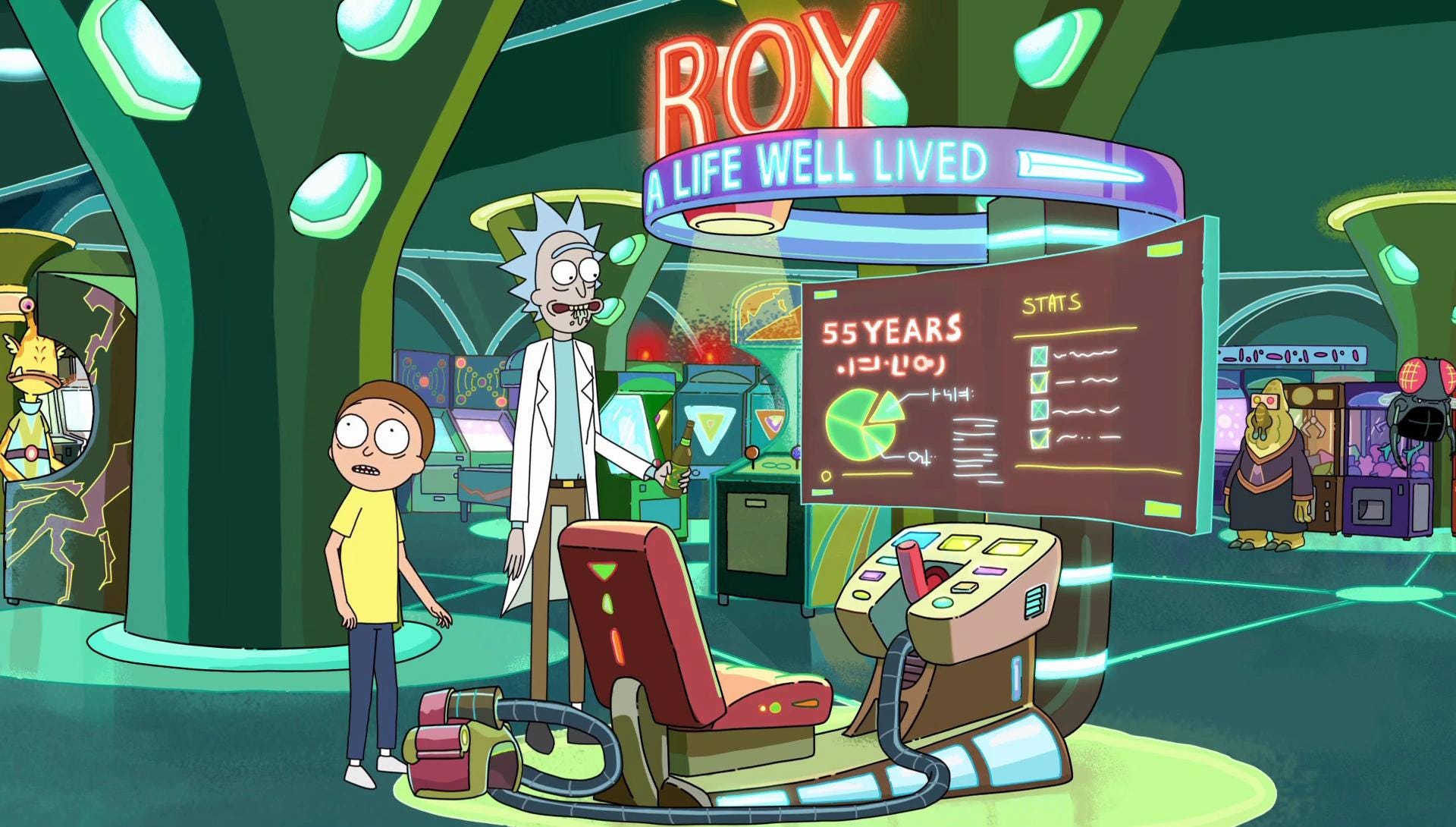
Rick and Morty toyed with this idea through Roy: A Life Well Lived, an arcade game where a player experiences a human lifetime from cradle to grave. Morty uses his playthrough to get married, raise a family, and beat cancer. Rick mocks this as a waste and takes his own Roy off the grid, to the delight of nearby spectators. The rubberneckers aren’t there to learn how to play Roy better, but to see what Rick makes him do next.
A life worth living is not necessarily a life worth watching. A player might want to remain loyal to Lucia, but the audience would rather watch him cheat with Mandy. A Roy who spends forty years happily married makes for terrible television.
If there is a market for a genuinely lifelike simulator—one that forces the player to swallow unfairness and irreversibility—its business model would resemble Twitch more than Rockstar. Rather than selling players the opportunity to navigate a fictional world, it could sell spectators the opportunity to watch it unfold. And what makes the simulation unfun for the player is exactly what makes it bingeworthy to the audience.
Of course, once you start designing an entertainment product around watching other people make terrible decisions and suffer the consequences, congratulations: you just invented reality television.
Game Over
Which brings me back to Lucia. Despite finding GTA VI fascinating, I feel little inclination to play it.
Playing a game that simulates love is less fun when you can’t afford to treat love like a game.
By the time I met my wife, I’d loved before. More than once. I made mistakes that became lessons, and those lessons became commitments I carried into my marriage. Sometimes, life does allow us to learn from previous runthroughs.
But that doesn’t mean I’ll get a replay. I’ve shared life-defining moments with a woman I’ll never speak with again. If you ever read this, I’m sorry and thank you. I can carry what I learned forward, but there’s no save point I can return to.
And now, with my son on the way, the stakes of commitment are becoming more consequential, more irreversible, and harder to control. Even if I do everything perfectly, my boy will develop a mind of his own and enter a world that will never care for him like I do. I don’t get to decide how this one ends.
But that’s what makes it meaningful.
Jason can reload an earlier save. I wouldn’t want to.
Works Cited
Adult Swim. “Roy: A Life Well Lived | Rick and Morty | Adult Swim.” YouTube, 3 Aug. 2015, www.youtube.com/watch?v=szzVlQ653as.
“‘A New Record for Entertainment’: Grand Theft Auto VI Sales Hit $3.8bn on First Day of Release, Developer Says.” The Guardian, 21 Nov. 2026, www.theguardian.com/games/2026/nov/21/a-new-record-for-entertainment-grand-theft-auto-vi-sales-hit-38bn-on-first-day-of-release-developer-says.
Das, Shimon. “GTA 6 Might Take Over 50 Hours to Complete, and That’s Barely Scratching the Surface.” Digital Trends, 16 Nov. 2026, www.digitaltrends.com/gaming/gta-vis-total-game-length-revealed-getting-your-moneys-worth/.
Manzon, Jim. “GTA 6 Launch Could Cost US Economy $1 Billion in Lost Productivity, Estimate Suggests.” International Business Times UK, 21 Oct. 2026, www.ibtimes.co.uk/gta-6-launch-could-cost-us-economy-lost-output-1826876.
Reed, Jim. “‘It gives me the ick’: Can you cheat on someone with a video game?.” BBC News, www.bbc.com/news/articles/ckn9wrr75dyeo.
Sydell, Laura. “Female Fans Love New Grand Theft Auto Despite Demeaning Content.” NPR, 20 Sept. 2013, www.npr.org/sections/alltechconsidered/2013/09/20/224300193/female-fans-love-grand-theft-auto-v-hate-it-demeans-women.
Wood, Austin. “How Long Is GTA 6? About 80 Hours, According to One Rockstar Dev’s Playthrough.” GamesRadar+, 27 Aug. 2026, www.gamesradar.com/games/grand-theft-auto/how-long-is-gta-6-about-80-hours-according-to-one-rockstar-devs-playthrough/.
Claude Opus 5.5 (Anthropic) was used for proofreading, fact-checking, and citation formatting.
All ideas, arguments, source selection, and writing are my own.