


Preface
When I first began to follow Harvard’s clash with the White House, I intended to write a timely update for families I advise: a strategic briefing for students and applicants navigating a volatile moment in U.S. higher education. But as I began to digest the news, I realized this episode revealed something deeper—a conflict I’ve wrestled with for most of my life inside elite education, from my first day at Phillips Exeter to my JD and MBA at Columbia.
At stake is a fundamental tension. Between the soul of education—its mission to form good citizens and flourishing individuals—and its body: the institutional machinery, the markets, the fundraising, the federal grants, the rankings. What we are witnessing is a collision between the university’s internal vocation and its being-in-the-world.
Yesterday, the temporary restraining order Harvard had secured against the Department of Homeland Security expired. Judge Allison Burroughs of the District of Massachusetts has now granted a preliminary injunction, effectively maintaining the status quo in Harvard’s international student admissions while the case winds through the courts. I believe Harvard will ultimately prevail. But I also believe the damage is already done—and not for the reasons most people think.
What we’ve witnessed over the last eight weeks has been Harvard’s Lehman Brothers moment. Not in the sense that Harvard itself will collapse—it won’t—but in the sense that the world has now glimpsed at structural vulnerabilities in a market many rarely consider: the Prestige Asset Market.
This market trades in an unusual asset class: the college degree and the human formation it supposedly represents. It is illiquid, opaque, and operates on unusually long time horizons. At the micro scale, the market is made up of students and institutions. At the macro scale, it includes sovereign nations competing for global talent. This market is ancient, older than the cursus honorum, Rome’s ladder of public office and credential. And today, even if no university will say so out loud, we have standardized and financialized its mechanisms. Higher education, in short, is Wall Street in slow motion.
So where does that leave families? It demands the mindset of a disciplined, long-term investor, one who sees past headlines and treats education as the durable, identity-shaping asset it is. As Epictetus reminds us, we must focus on what is ἐφ’ ἡμῖν—on what is within our control.
Families can feel like collateral damage as elite universities and the global superpower “bestride the narrow world like a Colossus.” But no institution determines your fate—not even if you’re an international student at Harvard in the summer of 2025. My role, and the role of Highly Selective, is to help you see the market’s decaying structures, and to show you the arbitrage. Not so you can panic, but so you can trade.
Table of Contents
I. Harvard’s Sharpe Ratio Has Fallen: Why a spike in risk—not a decrease in returns—is eroding the university’s prestige asset
II. Prestige, Marked to Market: How Harvard turns prestige into cash—and why the market is re-rating the asset
III. The Structural Risk Beneath the Headlines: Parsing the real and imagined fallout of Harvard’s sovereign risk event
IV. Winners, Losers, and the Long Game: What Harvard’s standoff means for admissions strategy and institutional alignment
V. Don’t Panic—Rebalance: How families can exercise portfolio discipline when the education market turns volatile
I. Harvard’s Sharpe Ratio Has Fallen
Why a spike in risk—not a decrease in returns—is eroding the university’s prestige asset
Harvard’s core asset is not real estate, research labs, or even its endowment. Its core asset actually doesn’t appear on its balance sheet. It’s prestige: a long-duration, intangible asset that underwrites everything from enrollment to donations.
In financial terms, prestige works like any other asset: it has a return (influence, outcomes, future earnings) and a risk (uncertainty, volatility, headline exposure). The ratio of the two is what investors call the Sharpe ratio. And this summer, Harvard’s Sharpe ratio has fallen—not because the returns have shrunk, but because the risks have spiked.
The Risk Event
The first escalation came quietly: on April 16, the Department of Homeland Security (DHS) sent Harvard a letter demanding disciplinary records for all international students allegedly involved in pro-Palestinian campus protests. That demand, based on student political activity, raised alarm bells internally, but it did not explode into the open until a month later.
Then, on May 22, the White House made its move, announcing that Harvard’s certification under the Student and Exchange Visitor Program (SEVP) would be revoked effective July 1. The consequences were immediate: without SEVP certification, Harvard would lose the ability to issue visas to new international students, effectively halting a significant portion of its admissions pipeline.
To be clear, DHS does have statutory authority under Title 8 of the U.S. Code to revoke SEVP status, typically when a school fails to meet reporting standards, poses a national security risk, or lacks academic legitimacy. But courts often distinguish between lawful authority and lawful motive. (See Department of Commerce v. New York, 588 U.S. ___ (2019).) SEVP revocations have historically been reserved for diploma mills and immigration scams—not global research universities.
Harvard argued it was being singled out under the pretext of national security. On May 23, a federal judge partly agreed, granting a temporary restraining order (TRO). On June 5, the court gave further credence to Harvard’s amended complaint. Yesterday, the TRO expired and DHS Secretary Kristi Noem raised the pressure, publishing a Washington Post op-ed that gave Harvard an exploding deadline of Friday, June 27, to comply with its SEVP demands. But later that evening, Judge Allison Burroughs granted Harvard’s request for a preliminary injunction, preserving the status quo as litigation proceeds.
So for now, Harvard’s SEVP status remains in suspended animation. There are whispers of a deal, but no one—not even the White House, probably—knows if it will materialize. The base case sees both sides digging in for trench litigation.
The Long War?
Barring some privately negotiated capitulation, a Supreme Court showdown is likely. Neither side can really afford to blink.
Harvard is unlikely to back down, because it is already fighting other legal battles with the administration, including over research funding. It hasn’t made the sort of conciliatory gestures that Columbia has, and it has given itself breathing room: fundraising has been strong, and the university recently raised new debt to bolster operating cash flow.
The White House, for its part, benefits from delay. There’s no acute market pressure (as we saw with the tariffs) forcing resolution. And politically, the administration may welcome the standoff: it allows them to look tough without taking a definitive loss. Now that the matter is in court, they have every incentive to contest it fully and every procedural excuse to slow-walk it.
Harvard would probably win in the Supreme Court. When I’m not advising students on admissions, I’m a securities oompa loompa at a corporate law firm, not a litigator. But one thing they did teach us at Columbia Law is this: you can sometimes do something for a good reason, and you can sometimes do something for no reason—but you can’t do something for a bad reason.
If the White House is using immigration law to punish a political adversary, that’s a bad reason. And bad reasons make judges uncomfortable, even in the Roberts Court. We saw that just last month in AARP v. Trump, when SCOTUS blocked the administration from using the 1798 Alien Enemies Act to deport Venezuelan nationals without notice. The separation of powers still functions. Unevenly, but not irrelevantly.
But an eventual win on the merits misses the point. Legal resolution could take years, and Harvard hemorrhages with every semester that its international students remain in limbo. The District of Massachusetts may take 6–12 months to decide on the merits. Add 6–9 months for the First Circuit appeal, then 3–6 months for certiorari and 6–9 more for a final SCOTUS decision. That timeline pushes clarity out to late 2027, just as the Class of 2032 begins to apply.
Meanwhile, DHS isn’t standing still. It appears to be tightening immigration channels through administrative means: slowing approvals, delaying visa appointments, and raising procedural barriers.
Some Harvard students, post-finals, have stayed in the U.S. out of fear they might not be re-admitted. Others have returned home and remain unsure whether they’ll be let back in September. If this drags six more weeks, some won’t return. In twelve weeks, seniors at international schools may simply opt out of applying at all.
The Market Reprices Harvard
Their hesitation reveals the core issue at stake. This standoff has already begun to reprice Harvard, both reputationally and financially. Prestige, although absent from the balance sheet, is a long-duration intangible asset—and Harvard’s core asset. It underwrites the university’s long-term strategy and its short-term liquidity.
The return on a Harvard degree hasn’t changed. Employers still hire on it. Global families still aspire to it. The payoff remains.
But the risk attached to pursuing a Harvard degree has gone up. The immigration infrastructure that supported global access is now visibly brittle. The legal terrain is unstable. The perception of elite American education as a safe bet—especially for international families—has cracked. This hurts Harvard’s standing as an international destination of formation.
So Harvard’s Sharpe ratio—the ratio of return to risk—has fallen. Not because the payoff shrank, but because the denominator grew.
This is more than a metaphor. In the Prestige Asset Market, families act as long-term investors in their children's futures. And they don’t just price value, they price reliability. Harvard’s long-term reputational capital once functioned like U.S. Treasuries: safe, liquid, globally convertible. Now, it’s being repriced like an emerging-market bond when the sovereign turns hostile.
But in a world where prestige is financialized, Harvard just experienced a write-down.
II. Prestige, Marked to Market
How Harvard turns prestige into cash—and why the market is re-rating the asset
U.S. GAAP defines an asset as “probable future economic benefits obtained or controlled by a particular entity as a result of past transactions or events”. Although it appears nowhere on its balance sheet, prestige is an asset for Harvard because it can turn long-term prestige into money today. International students are just one of the many ways Harvard converts prestige into present cash flow.
A nifty public relations arbitrage
Harvard says it meets 100% of demonstrated financial need for all admitted students, including international ones. But the data (and common sense) say most international students pay sticker. Harvard doesn’t break this out in public reporting, but we can infer it. (Secretary Noem cited $383.6 million as a figure in her op-ed, but this number estimates total economic contribution of international students, including job creation. The true figure is not public.)
First, the street view. I’ve split my time between NYC, Paris and London on the elite admissions circuit for years. Here’s what I see:
Network effects. Why would a family choose Harvard over ENS, LSE, or Bocconi? Because someone in their network already went. That narrows the pool.
Sticker shock. In countries with state-funded higher ed, the idea of paying $80,000 per year is hard to fathom. UK and France average household incomes hover around $47,000. Most families don’t even get far enough to read the fine print about financial aid.
Access and infrastructure. Fewer testing dates, more distant testing centers, and counselors with limited experience navigating the Common App—all of these raise the cost of applying.
One could almost call Harvard’s international financial aid policy a public relations arbitrage. It earns reputational credit for funding students who, in practice, are structurally discouraged from applying in the first place.
C.R.E.A.M. of the crop
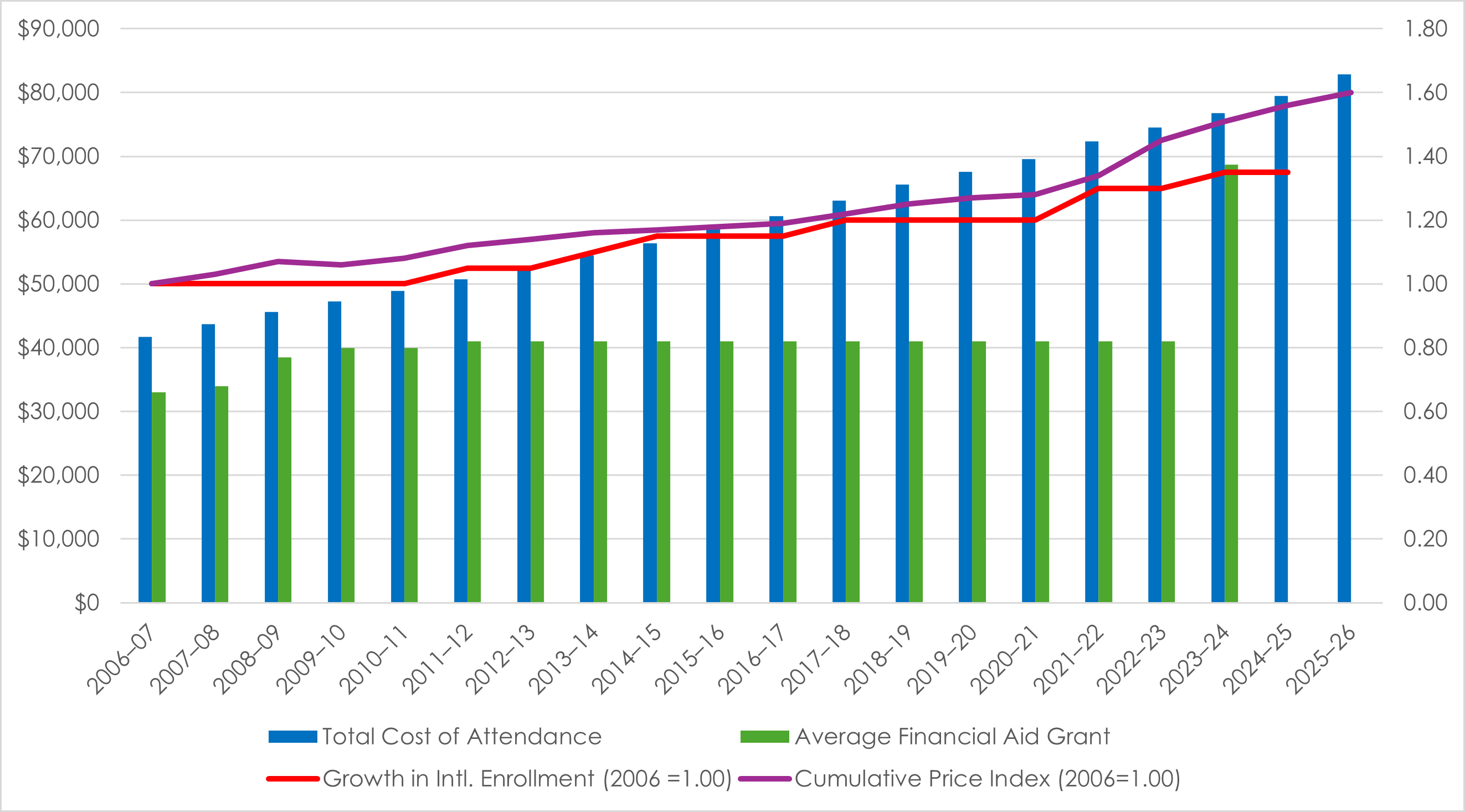
Next, the data. Between 2006 and 2025, Harvard’s total cost of attendance and international student enrollment have climbed with inflation, but the nominal average financial aid award stayed flat at $41,000 from 2009–2022.
Figure 1: Harvard College Total Cost, Financial Aid, and International Student Enrollment (2006 - 2025).
During the same period, the real value of the average financial aid package fell by 33%, while the percentage of students receiving financial aid declined from almost 70% in 2009 to 55% last year (Source: Harvard University).
Figure 2: Harvard College Total Cost and Financial Aid (2006 - 2025, adjusted to 2006 dollars)
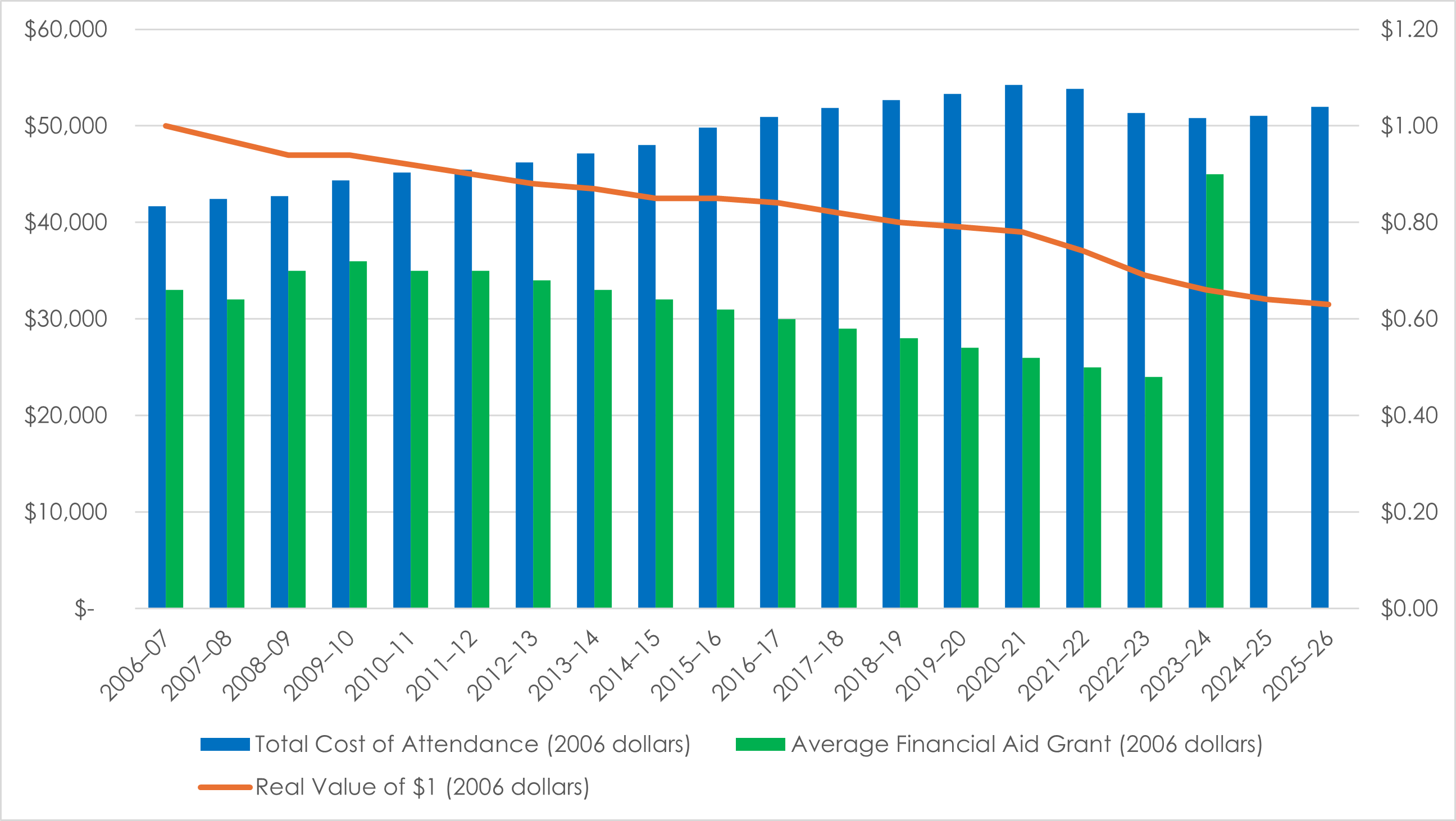
There was a spike in 2023 when Harvard expanded aid for low- and middle-income families. But long-term, international enrollment rose while the generosity of aid packages declined.
As a scholarship kid, it was jarring to graph this out. It doesn’t make Harvard a villain, but it explains why some Americans don’t see Harvard as a hero either.
Harvard’s international students matter not just for this year’s revenue, but for the long-term yield on its most intangible asset: prestige. They are high-margin customers, yes—but also prestige multipliers. As the Wu-Tang Clan said, cash rules everything around me, and international students are the C.R.E.A.M. of the crop.
The balance sheet revalues, then cash flow reacts
But this is where the pundits invert causality. Observers correctly note that a decline in international enrollment affects Harvard’s bottom line. From there, some argue that shrinking revenues or a smaller endowment will eventually erode prestige. But it's the other way around.
When Harvard’s Sharpe ratio falls—when reputational risk rises relative to perceived reward—that signals a market reassessment of its long-term intangible asset: prestige. In accounting terms, this amounts to a write-down in its non-current intangible assets—the stock of reputational capital Harvard draws on to maintain relevance and command revenue.
And when the market marks down that asset, it constrains Harvard’s ability to convert prestige into present cash flow. So the White House’s attack on Harvard’s prestige is ontologically prior to its attack on Harvard’s bottom line.
III. The Structural Risk Beneath the Headlines
Parsing the real and imagined fallout of Harvard’s sovereign risk event
So far, only Harvard has received scrutiny this severe. But that hasn’t stopped a wave of anxiety from sweeping through higher ed. I would urge a calmer reading.
Overstated near-term risks
Worst-case scenarios dominate headlines, but many of them are less likely than they seem. Let’s examine a few.
Policy Contagion
Some worry that Harvard is the Helvetii: the first tribe Caesar struck in his conquest of Gaul—not for its power, but for what it symbolized. If the White House can break Harvard, what stops it from advancing on Columbia, Stanford, or Penn? Theoretically, nothing. But so far, DHS has issued no similar letters elsewhere. Columbia’s more conciliatory stance may have helped it avoid confrontation. Unless the pattern repeats, this may remain a one-off skirmish rather than the opening of a campaign.
Financial Aid Fallout
Yes, international student tuition helps subsidize domestic financial aid. But so do certain domestic full-pays. Schools might shift recruiting toward high-income U.S. postal codes. Plus, elite colleges have other income streams: endowments, graduate tuition, research grants. Harvard alone raised over $1 billion in gifts last year and hasn’t touched levers like adjusting merit thresholds or loan portions. So this is not a meaningful near-term risk, but what we should be watching is a long-term write-down in prestige across all U.S. higher ed.
College Town Economies
Some argue that local economies (think Amherst, West Lafayette) rely on international students. But the gloomiest forecasts assume those students won’t be replaced. In reality, colleges will likely backfill with high-paying domestic admits.
Long-term, market structure risks in U.S. higher ed
That said, the real risks are structural, longer term and harder to quantify. They play out slowly, or at the level of market and culture.
Sovereign Risk and Short-Term Funding on Long-Term Assets
Let’s strip away the First Amendment and ideological framing for a moment and look at universities’ relationship to government in strictly market-driven terms. Before 2025, few fully grasped the extent to which universities depended on federal support, and fewer still recognized that this dependence posed a structural risk.
Much like Lehman Brothers in 2008, which relied on short-term repo funding to finance long-term assets, universities have spent decades accumulating prestige—an illiquid, long-duration asset—while funding it with short-term federal liquidity: visa regimes, research grants, regulatory favor.
Now, as the sovereign turns hostile, Harvard is being repriced like an emerging-market firm under political stress. The fundamentals may not have changed—but the sovereign risk premium just did.
Long-Term (Human) Capital Management
The policy argument is simple: scaring off international students harms U.S. innovation. The contra view, of course, is that someone else would have built a Stripe if Patrick Collison hadn’t come to MIT as an Irish schoolboy.
But that misses the deeper macroeconomic point. Elite universities don’t just educate global talent—they underwrite it. They serve as market-makers in a sovereign-scale auction for minds. In that sense, the United States didn’t merely host the university that educated Collison. It won him, with MIT acting as lead bookrunner in the global human capital markets.
The trouble is, that market structure has changed. Like Long-Term Capital Management in 1998, elite universities built global strategies on assumptions of political liquidity and structural convergence. But now, as sovereign posture shifts, their portfolios are being marked to reality.
Cultural Erosion
The harder loss to model is cultural. International students make American campuses richer—not just economically, but socially and intellectually. They bring global perspectives, shift conversations, and make late-night dorm debates more interesting.
If international students vanish, domestic students won’t just lose peers. They’ll lose something they didn’t even know they were buying: the cosmopolitan oxygen that gives elite campuses their intellectual character.
This assumes, of course, that internationalization is a positive good. Not everyone agrees anymore. But for most families shopping for elite education, it remains part of the value proposition.
IV. Winners, Losers, and the Long Game
What Harvard’s standoff means for admissions strategy and institutional alignment
When policy shocks ripple through higher education, the impacts aren’t distributed evenly. The White House’s decision to target Harvard’s SEVP certification—whether strategic or symbolic—has created clear beneficiaries, probable casualties, and some parties left nervously watching the headlines. Here's how the early fallout is shaping the strategic landscape. This is also where the strategic implications come into focus for families navigating the new terrain.
Winners
Domestic students who can pay full tuition
These students become more attractive marginal admits at elite universities. With fewer international full-pays in the mix, admissions offices under pressure to meet revenue targets will naturally lean into wealthier domestic zip codes. Even at schools that are nominally “need-blind,” enrollment management is often not.
Selective schools outside the Ivy League drama
Think WashU, Vanderbilt, Emory, Tufts, Wesleyan, and USC. These schools are seen as academically rigorous but less politically radioactive. For international families wary of the immigration-political nexus, they are becoming safer bets, offering global prestige with fewer headlines.
Private and elite public high schools in the U.S.
Schools like Andover, Chapin, and Menlo-Atherton indirectly benefit because elite colleges often see them as pipelines to full-pay, low-risk domestic students. Even when financial aid decisions are made independently, admissions officers view these schools as signals of cultural and academic fit.
Competing global universities
Top-tier institutions in the UK (Oxford, LSE), Europe (IE, Bocconi, ETH Zürich), Canada (McGill, Toronto), and Asia (NUS, HKU) stand to absorb some of the high-caliber international students turned off by U.S. volatility. Many already have English-language programs and smoother visa policies, and many of these institutions are already seeing a dramatic uptick in U.S. applicants.
Losers
International students applying to U.S. colleges
This cohort bears the brunt of uncertainty. Visa risks, long delays, and the specter of abrupt policy change increase the perceived fragility of a U.S. education investment. Even if only one school is directly targeted, the ambient fear can chill the entire applicant pool.
Harvard, and schools like it
Harvard faces immediate risk to revenue, legal costs, and long-term damage to its reputation as an internationally neutral site of intellectual life. Peer schools—especially those who might resist federal pressure—are taking note and bracing for their own tests.
U.S. colleges with smaller endowments but large international enrollments
Public flagships (e.g. Purdue, UMass Amherst, Michigan State) rely heavily on international full-pays to balance budgets. If international students view U.S. education as riskier overall, these institutions will feel the squeeze most acutely.
Academic departments with global pipelines
STEM PhDs, research-heavy economics programs, and policy schools have long depended on international talent. A chilling effect on student inflow can mean fewer research assistants, lower publication output, and eventually less grant competitiveness.
“Stay the course.” — Jack Bogle
Speaking now as someone who’s spent years guiding families through elite admissions, the most important truth I can offer is this: colleges and degrees are tools, not masters. They are means, not ends—stepping stones toward a meaningful life, not its guarantors. They exist to serve your purpose, not to supply it.
Understanding the broader shifts—like the ones unfolding now—can help you devise your strategy. Your task, like that of any disciplined investor, is to interpret the signals, adjust your position, and invest in the future you intend to build.
V. Don’t Panic—Rebalance
How families can exercise portfolio discipline when the education market turns volatile
The Prestige Asset Market is no longer frictionless. Regulatory shocks, geopolitical risk, and institutional volatility have introduced new variables. But for students and families, the correct response is not to panic—it is portfolio discipline. In investing, volatility is a feature, not a flaw. What matters is time horizon and clarity of purpose.
For international students: hedge your bets. Transfer deadlines in the U.S. may have passed, but a few European schools (like IE in Spain) are still open. Especially if you are a rising senior, the odds are better than not that you’ll be able to return in the Fall to finish your degree. Still, a backup offer might ease the mind.
For families applying this fall: don’t panic. Applications aren’t due for months, and clarity should come well before the Nov 1 deadline. Your energy is better spent on things you control: crafting your personal statement or maximizing SAT/ACT scores. Think of your college list as a diversified (but not fully uncorrelated) portfolio of call options. Each application costs something upfront but offers future upside. After the first app, the marginal cost of the next app declines. If your list is well-designed, adding or removing Harvard shouldn’t be the make-or-break.
In this market, your capital is not just your money—it’s your time, your mind, your effort, your formation. And the only asset you truly control is yourself. As the Stoics remind us, the external world may shift, but your own judgment, effort, and virtue remain ἐφ’ ἡμῖν—within our power.
Donc, ayez du courage. Even in a turbulent market, calm, long-term investors prevail. Ladder your risks, hedge your downside, and stay focused on intrinsic value. The wise don’t chase prestige—they wield it.
Updated June 27, 2025 to include cover image.
You’re reading Highly Selective, a strategic briefing on education, prestige, and long-term human capital. If you found this helpful, consider subscribing or sharing with someone navigating the college admissions market.
About Me
I’m the founder of Classical Advisors, where I help students and families think strategically about elite admissions, early careers, and long-term human capital. Over the last decade, I’ve advised high-performing students across New York, London, and Paris—with recent placements at Harvard, Yale, Princeton, Penn, Duke, and the Sorbonne. My career advisees have gone on to internships and full-time roles at UBS, Citi, Carlyle, Piper Sandler, and more.
I currently work in London on the U.S. Corporate Finance team at A&O Shearman, focused on capital markets and leveraged finance. I earned my JD and MBA from Columbia, hold undergraduate degrees in Applied Mathematics and Classics, and graduated from Phillips Exeter Academy. On parle français chez nous, and I also read Latin and Ancient Greek.
If you’d like strategic guidance—or want to work together—reach out anytime: raphael@classical.nyc.