


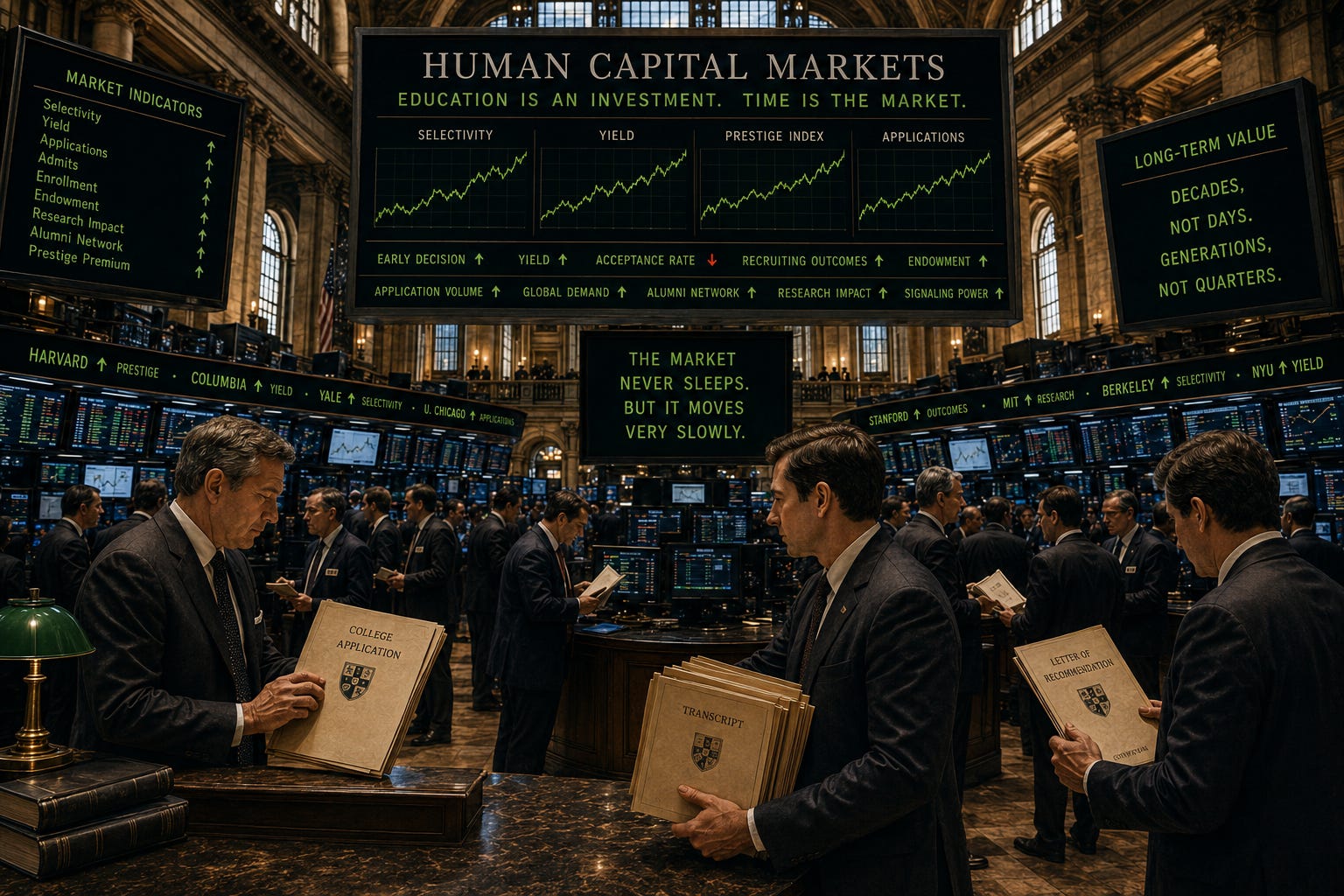
An idea that crystallized for me during my MBA at Columbia is that much of what happens in higher education can be modeled using the language of financial markets.
For example, I’ve said before that a college app is a call option.
When a student writes her college apps this November, she’ll pay an immediate, known cost for an uncertain future payout. The cost today is the application fee ($75), any fees paid to coaches and consultants, and the opportunity cost of spending a few hours writing the app versus studying for Senior Fall exams, making $20 an hour at Chick-fil-A, or playing Fortnite.
The option’s upside is a chance at admission (i.e., the right but not the obligation to enroll) at Columbia the following April. The full payout may not come until years later, when she’s recruited from a target school for a highly paid job or when she meets a new client mid-career at the University Club.
Her college list is a portfolio of options like these. But here’s the wrinkle: they’re not uncorrelated. The kind of student who gets into Dartmouth is the kind that also gets into Brown. That’s why schools use binding Early Decision programs to lock up talent and boost their yield (the ratio of students enrolled to total admissions offered). That’s also why financial aid packages are sometimes negotiable if you can play offers against each other.
Diversification is still the cardinal risk management principle, but it looks a little different. Applying to HYP is not placing three different bets, but placing the same bet three times. Real diversification in this context means building your portfolio across selectivity bands, geographies, and evaluation frameworks (e.g., applying to essay-driven schools like UChicago alongside numbers-driven schools like UC Berkeley).
A preternaturally patient and strategic student might even run a small-cap alpha long-dated call play: target a regional undergrad, max out their GPA while having time to kite-surf, and leverage killer stats at a top law or med school, which are both very numbers-driven. (Parents usually insist I prep their kids for the Princetons and Yales—I oblige—but the one person who took this advice got into a great med school and had ridiculous fun along the way.)
The early career version of this trade is skipping the bulge bracket after graduation, crushing it at a boutique, and entering PE as an associate. Same logic, different market.
Wall Street in Slow Motion
But that long-dated, kite-surfing prestige trade only works if the student is actually good, and stays good for four straight years.
The core difference between financial markets and education markets is time horizon, and that difference starts with the assets being traded: human capital and prestige. Both are costly to acquire, hard to exchange, volatile in perception, and painfully slow to reprice.
So while education markets follow the same basic logic as financial ones—valuation, signaling, and risk—they’re slower, stickier, and illiquid.
(I call this the Prestige Asset Model, at least in my head.)
As a result, transactions in education markets unfold on geological time scales. That has consequences.
1. Time Lag Kills Most Arbitrage
A key difference is how long it takes for a trade to “clear.” If you bought MRK last Monday, you knew it was a good trade by Thursday. In education, you “buy” a college choice at 17 but don’t know how it pans out until you’re 27 (or 47).
The student who chooses a lower-prestige undergrad to dominate and get into Harvard Law doesn’t get to realize that trade unless they execute flawlessly for four years. There’s no partial credit, no way to exit the position early, no real-time pricing data.
Arbitrage exists, but it’s gated by performance, discipline, and time. It’s not enough to see the inefficiency. You have to live inside it long enough to prove it was real.
(For institutions, arbitrage is faster, like when a domestic university opens a “Global Center” in Abu Dhabi or another location where they have lower operating costs, all while charging U.S. tuition.)
2. Bubbles Don’t Pop, They Deflate Slowly
In finance, a bubble can burst in a day. In education, even if everyone knows a credential is overpriced, it can take a generation for the labor market, cultural norms, and institutional behavior to catch up.
We’re currently living—and have been for some time—inside an elite college prestige bubble. Everyone’s asking whether $350,000 for a bachelor’s is “worth it.” But top firms, top grad schools, and elite social networks still use those brands as filters.
Economists Raj Chetty, David Deming, and John Friedman, working from tax and admissions records, find that attending an Ivy-Plus college rather than the average state flagship raises the odds of reaching the top 1% of earners by 50%, nearly doubles the odds of an elite graduate program, and almost triples the odds of landing at a prestigious firm. For the typical graduate, though, the Ivy-Plus credential does almost nothing: no meaningful effect on the chance of reaching the top quartile, on earnings rank, or on log earnings.
In other words, the Ivy-Plus brand increases the likelihood that certain gatekeepers will filter your application upward in the tail case, but the median family will correctly view the $350,000 sticker price with skepticism.
So the bubble floats on, buoyed by inertia, signaling, and a lack of short-term feedback. If the current turmoil in higher education signals a long-term devaluation of Ivy League credentials, don’t expect it to affect Chip or Peyton when they apply this fall. Expect it when their Class of 2031 retires.
3. Failure Is Quiet, Not Sudden
In finance, bad trades fail loudly: Greensill, Archegos, Credit Suisse, FTX. In education, failure is much quieter. A student burns out. A résumé doesn’t get callbacks. A school slips a few ranks or loses a few star faculty. Not a collapse, just erosion.
That makes it harder for the market, or its participants, to self-correct. There’s no central exchange for outcomes, and the feedback loop is messy, anecdotal, and delayed.
I’ve watched more than a hundred families go through this process, but my vantage point isn’t typical. Most parents are working off a much smaller sample: their own child, or a handful of family friends.
Fundamental Analysis
There are three things I’d like to emphasize here.
1. Real Markets
First, financial markets aren’t an analogy for education. Education is made up of actual markets:
The market for students (admissions)
The market for credentials (recruiting)
The market for institutional prestige (rankings, endowments, donors)
The market for executive talent (Columbia just hired a new president)
The market for grant funding, both internal (among faculty) and external (from the federal government or foundations)
These are slow, fuzzy, but functioning markets, governed by the same logic as financial ones, just with less standardization and a different set of gatekeepers.
2. Drift and Diffusion
Second, the classical purpose of education—to equip a young person with skills, discipline, ethics, and creativity—still matters. Over time, it is the only thing that does.
Recall where we started: a college app is a call option. What options teach us is that the value lives in the (random) Brownian motion of the underlying asset. And here the underlying asset is a person, which is the one thing no one can trade.
By analogy to Brownian motion, the position of your long term human capital has two components: drift and diffusion. The drift is the fundamental: raw human capital, plus the badly underrated knack for turning in your homework on time for four straight years. The diffusion is everything else: the bad first manager, the parent who falls ill junior year, the cruelty of graduating into a spring when no one is hiring.
Drift accumulates with time, while noise only accumulates with its square root. Over a single semester the noise drowns the drift, which is just to say the near term is all sequencing and luck, no partial credit, no live quote.
On the longer timescale of a whole career, the arithmetic flips: the drift has grown compoundingly while the noise has hardly kept pace. This is when your fundamental human capital, the hard and soft skills gained through genuine education, steps out of the static.
A life is not a series of independent trials, each year forgetting the last; it’s a random walk with drift, where the steps compound and the past is carried forward. That dependence makes a bad admissions or recruiting cycle genuinely hazardous. But drift is patient. Run it long enough and it wins.
3. The Absorbing Barrier
So it would be a slight overstatement to say volatility decays. More accurately, transitory noise washes out (you stop being judged on one bad grade or one lackluster performance review), while the permanent differences fan out. This is why the truly capable pull away from their classmates the way earnings curves splay upward over time. In the long run, nothing matters more than fundamentals.
There is one exception, and it’s the dark one. Drift only pays if you’re still at the table to collect it. Every position has an absorbing barrier, a floor you don’t come back from once you touch it. Extreme examples include a felony conviction, dropping out of school with no path to recover, or permanently burning out.
Even a trajectory with strong positive drift carries a real chance of touching that floor, and the danger is front-loaded, with high school and early career carrying the highest risk before track record has bought any distance from the edge.
The market’s slowness is usually benign, since it prices you correctly in the end. The tragedy is reserved for the few who draw a bad hand early and leave the table before the drift can speak. The market takes thirty years to value you fairly, and not everyone gets thirty years.
So in the trenches of a typical semester, my job as a tutor and coach is more akin to a traditional business manager: allocating effort, deploying time, providing feedback, advising on marginal investments (do this summer program, not that one). All this in service of building sustainable, long-term value.
So while my profession involves managing diffusion (hedging risk through an admissions or recruiting cycle), my calling as an educator is to manage drift: the slow accretion of human value over years. But there are forks in the road, like the college admissions sprint, that feel way less businessy and much more financey—and now I can say why. They’re the near-barrier, high-variance moments, when the diffusion is loudest and the floor is closest.
This is why I get most involved in my advisees’ lives early (during high school and college): not because I’m any less useful to someone already established, but because the stakes are asymmetric at the start of a career.
Works Cited
Chetty, Raj, et al. Diversifying Society’s Leaders? The Determinants and Causal Effects of Admission to Highly Selective Private Colleges. National Bureau of Economic Research, July 2023, https://doi.org/10.3386/w31492. Accessed 29 June 2026.
Diep, Francie, and Nell Gluckman. “Can Jennifer Mnookin Heal Columbia?” The Chronicle of Higher Education, 26 June 2026, www.chronicle.com/article/can-jennifer-mnookin-heal-columbia. Accessed 29 June 2026.
Claude Opus 4.8 (Anthropic) was used for spell-checking, proofreading, fact-checking, and citation formatting. ChatGPT (OpenAI) was used to generate the header image.
Edited 29 June 2026 to add the cover image and make minor formatting fixes.
All ideas, arguments, source selection, and writing are my own.